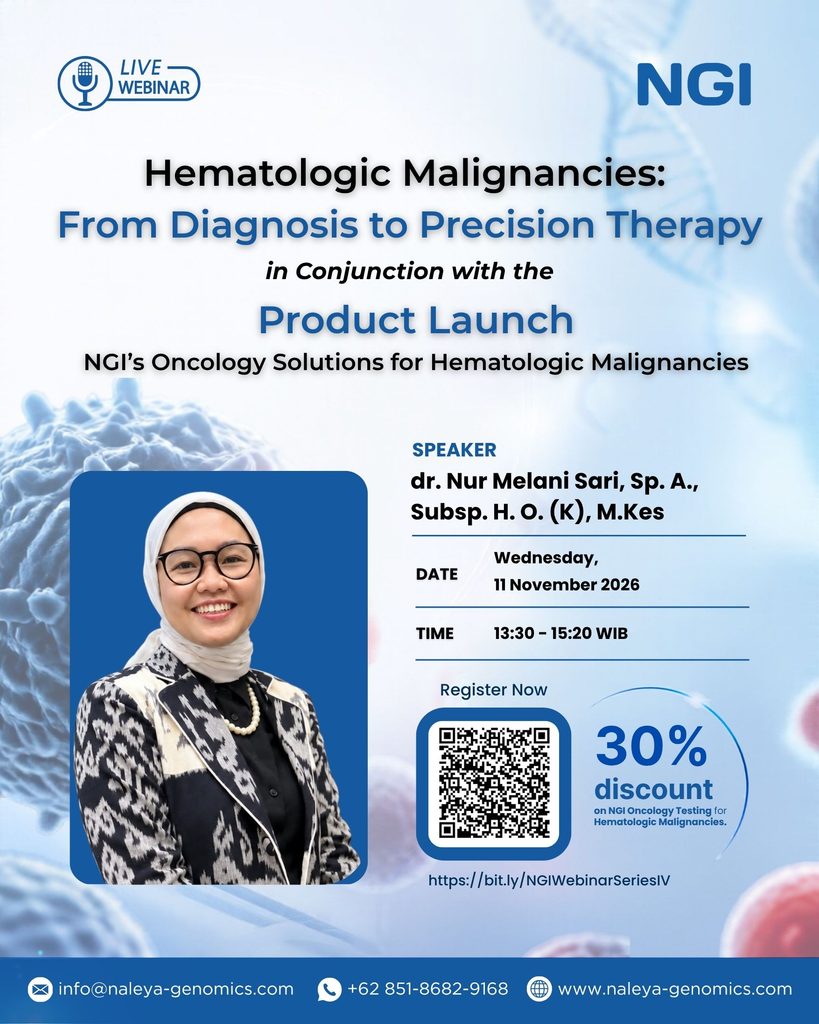
Genetic and molecular findings now shape how hematologic malignancies are diagnosed, treated and monitored. On 11 November 2026, NGI launches its Oncology Solutions for Hematologic Malignancies with a live clinical webinar.
A significant burden in Indonesia
Hematologic malignancies account for nearly one in ten new cancers in Indonesia: an estimated 47,288 new cases and 27,410 deaths per year, led by leukemia (21,912 cases) and non-Hodgkin lymphoma (19,826 cases) [1]. Leukemia is also the most common childhood cancer, representing 60% of pediatric malignancies in the Yogyakarta Pediatric Cancer Registry [2].
Why genomic testing matters
The WHO 5th edition classification (WHO-HAEM5), the International Consensus Classification and the ELN 2022 AML recommendations now define many entities and risk groups by their genetic lesion [3–5]. Genomic testing therefore supports three key decisions:
- Diagnosis and risk stratification: confirming the entity and assigning genetic risk, for example NPM1-mutated AML as favorable and FLT3-ITD AML as intermediate risk [4, 5].
- Therapy selection: identifying targetable lesions such as BCR::ABL1, FLT3 and IDH1/2, or KMT2A rearrangement and NPM1 mutation for menin inhibitors [4, 6].
- Monitoring: NGS-based measurable residual disease (MRD) testing can detect one leukemic cell in a million (10⁻⁶), compared with 10⁻⁴ for standard flow cytometry [7].
Because no single method detects every lesion, best practice combines Morphology, Immunophenotyping, Cytogenetics and Molecular testing (MICM).
NGI’s Oncology Solutions for Hematologic Malignancies
Built on the MICM principle, NGI’s NALEYA® Oncology portfolio covers ALL, AML, CML, CLL, MDS, MPN, multiple myeloma and lymphomas, from diagnosis through long-term monitoring.
Join the webinar
Hematologic Malignancies: From Diagnosis to Precision Therapy, in conjunction with the product launch of NGI’s Oncology Solutions for Hematologic Malignancies.
🗓️ Date: Wednesday, 11 November 2026
🕒 Time: 13.30 – 15.30 WIB
Speaker: dr. Nur Melani Sari, Sp.A., Subsp.H.O.(K), M.Kes — Pediatric Hemato-Oncologist, Dr. Hasan Sadikin General Hospital, Bandung
Selected participants will receive a 30% discount on NGI Oncology Testing for Hematologic Malignancies.
For healthcare professionals. Test selection and treatment decisions remain the responsibility of the treating physician.
References
- International Agency for Research on Cancer. GLOBOCAN 2024: Indonesia fact sheet. Global Cancer Observatory, 2026.
- Supriyadi E, et al. A province-wide childhood malignancy profiles in Indonesia (2010–2019): Yogyakarta Pediatric Cancer Registry. Paediatr Indones. 2023.
- Khoury JD, et al. The 5th edition of the WHO Classification of Haematolymphoid Tumours: Myeloid and Histiocytic/Dendritic Neoplasms. Leukemia. 2022;36(7):1703–1719.
- Döhner H, et al. Diagnosis and management of AML in adults: 2022 recommendations from an international expert panel on behalf of the ELN. Blood. 2022;140(12):1345–1377.
- El Chaer F, Hourigan CS, Zeidan AM. How I treat AML incorporating the updated classifications and guidelines. Blood. 2023;141(23):2813–2823.
- American Association for Cancer Research. Revumenib approved to treat certain cases of acute myeloid leukemias. 2025.
- The emerging role of next-generation sequencing in minimal residual disease assessment in acute lymphoblastic leukemia: a systematic review of current literature. Front Med. 2025;12:1570041.